The London Design Biennale went in search of the relationship between utopia and design in its first edition.
The London Design Biennale went in search of the relationship between utopia and design in its first edition.
Is design finally becoming political? Are we about to see designers get involved in social discussions? For the makers of the London Design Biennale (LDB), the point is clear: "The Biennale explores the big questions and ideas around sustainability, migration, pollution, energy, cities and social equality." Debate hardly gets any smaller these days. Still, the theme of "Utopia by Design" for the first edition of the Biennale makes sense. Using the tools of design to discuss the state of this world or another - institutions and designers from 37 nations took up the Biennale's challenge.
The Somerset House as an exhibition venue is historical scenery, the utopian approach too. The organizers seek with the theme after 500 years the reference to Thomas Morus, who in 1516 in his work Of the Best Constitution of the State and of the New Island Utopia designed an ideal, at least, however, a society deviating from the existing conditions. Utopia as an ideal deviation. A dream, a stroke of luck, a great idea, which is hardly attainable in reality. In the contributions to the LDB, the idea of utopia shrinks to short-term goals and everyday scenarios. Rarely with an open, wide view, often present and unfortunately now and then just banal.
Installation in black and white
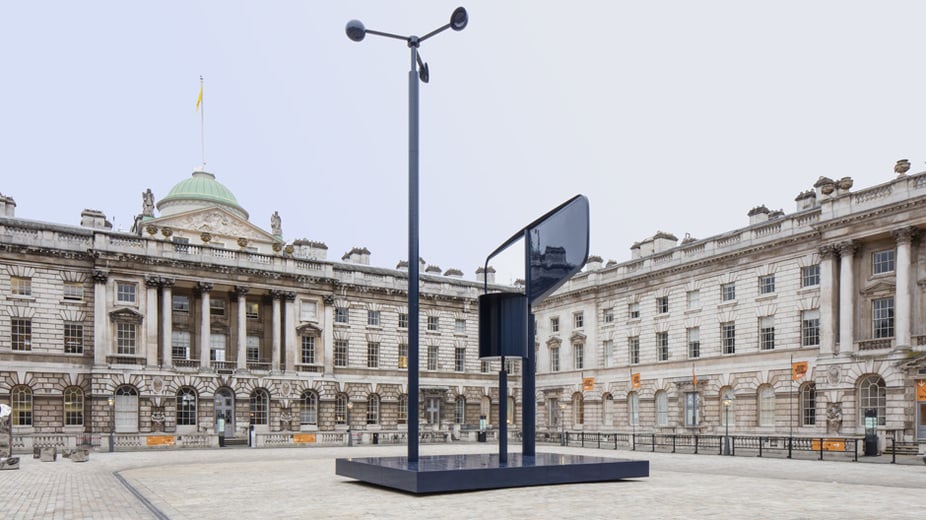
Konstantin Grcic is responsible as curator and designer for the German contribution Utopia means elsewhere. The Munich designer has conceived an installation in black and white. Two aestheticized spaces that leave room for visitors' own perceptions and thoughts. Grcic's thesis: "Utopia eludes any depiction, it always moves in the realm of subjective interpretation." Utopia as an intellectual construction is circled, and visitors can then ponder their own utopia(s) in front of the digital fire.
Utopia without implementation
So can design and the designers qua self-conception deliver utopias at all? Or does the design of (social) possibilities remain a field of philosophy or art or politics? Design is actually already suitable as a form-giver for utopias, as the contribution from Russia, for example, tries to prove from the past. For the first time since the end of the Soviet Union, the Moscow Design Museum is opening an archive of works by Russian designers from the 1960s to the 1980s. Most of the designs and projects - some certainly with utopian perspectives - were never realized. Mainly because of economic restrictions, even the state organization of design activities did not help. So what good is the greatest utopia if hardly anyone is interested in or capable of implementing it?
Mental border crossings
Utopias are mental border crossings. The LDB contribution of Mexico provides the practical dimension right away. While in the current American presidential election campaign the Republican candidate is fantasizing about a border wall with the neighboring country to the south, Mexico comes up with the vision of a Border City. A bilateral city that collectively provides answers to all the long-standing questions at the interface of the two systems. It is not the idea of practical implementation that poses difficulties here, but design and architecture have all kinds of solutions at the ready. Utopian still seems to be the open and constructive confrontation of the different societies with the creeping more difficult situation. The more present and clear utopias are or are described, the clearer opposing constraints and obstacles become.
Everyday life as lived utopia
"The opening biennial is more reality than dream," Paolo Antonelli, senior curator at MoMa New York and jury member of the LDB, states. In most of the contributions, the path to a better future is not marked out by a "powerful and absolute vision," but leads through contemplation of past constellations and recognition of present positions. Quite so in Lebanon's excellent contribution. AKK Architects have placed a reconstruction of a section of Beirut city life in front of Somerset House on the Thames. Antonelli praises this vividly colorful image as an "ever-functioning theatrical ruse" that celebrates "utopia in daily life." Everyday life as lived utopia, a reassuring notion.
Utopias through small improvement
The Swiss contribution, also awarded a prize, a joint project of seven design studios with respective industrial partners, also seeks a dynamic relationship between utopia and everyday life under the title In-between: The Utopia of the Neutral. For all the speculation about the neutral as a "catalyst for dialogue and movement" and the "in-between" as a space without conditions, the reference to Max Bill's utopia of the "Good Form" must not be missed. The bottom line for the Swiss is thus the unceasing effort. Utopias can be achieved not only by great upheavals but possibly even more successfully by continuous small improvements.
In other words: Utopias make trouble, the debates around them also. It is all the more important that with the London Design Biennale a new format has been found that seriously discusses design beyond endless product presentation. The popularity of the visitors as well as the diversity of the presented positions prove that the discussion about the social impact of design is highly welcome.
The Best Time To Cut Back Peonies


Comments
Post a Comment